Frequently Asked Questions About Chastity - Chastity Cage
Free shipping on orders over $69! 🎁 Buy two cages, get a belt free

Frequently Asked Questions About Chastity

This article mainly provides some common questions and answers about chastity. If you have any other questions, feel free to leave a comment below the article, and we will answer them one by one.

Table of Contents

Chastity Questions for Beginners

Which type of chastity cage is most suitable for beginners?

Beginners should avoid flat, inverted, or spiked designs. Plastic cages that come with multiple ring sizes are more suitable, as they make it easier to find a base ring that fits properly.

How much does a first chastity cage usually cost?

It’s recommended to spend under $50, as there are already very good chastity cage options available within this price range.

How long is it appropriate to stay locked for the first time?

Do not exceed 10 minutes the first time. After removing it, check for redness, swelling, or signs of restricted blood flow. Gradually increase the duration step by step. If any pain occurs, it’s recommended to stop immediately.

What should you do if you feel panic after being locked?

Don’t worry—panic is just a psychological reaction. In reality, you’re simply wearing a toy, and it can be unlocked at any time.

Can chastity be addictive?

Once you get used to it, it can become addictive—you may start to feel like you need to stay in the cage.

I’m just curious—does this count as already falling into the rabbit hole?

Not really. Just being curious doesn’t count as getting into it. “Getting into it” usually means you’ve started practicing, invested time, or developed a consistent interest. Simple curiosity is just interest in the topic—it’s still the exploration stage.

Is it normal to practice chastity alone?

Completely normal. Practicing chastity alone is very common. Many people do it for self-exploration, sexual self-control, or to add a sense of excitement, and it doesn’t require a partner’s involvement. As long as it’s safe, hygienic, and can be unlocked at any time, it’s a perfectly normal niche interest.

Is it worth buying a better quality one the first time?

Not necessarily worth it. For your first time, it’s recommended to choose a beginner or basic model, focusing on proper sizing, comfort, and safety. Start by experiencing how it feels and understanding your own tolerance, then consider upgrading later. Jumping straight into an expensive or complex model may not be suitable for beginners and can increase risks.

Is chastity a phase-based interest?

For many people, chastity can indeed be a phase-based interest. They may be especially curious or actively involved for a certain period of time, but as time passes or their mental state and life circumstances change, the interest may fade or even disappear. However, for some people, it becomes a long-term interest and a consistent kink.

What age is appropriate to start?

The most appropriate time to try it is after reaching legal adulthood, usually 18 years old or older. At this age, physical development is largely complete, and individuals have the ability to make independent decisions, understand legal responsibility, and protect themselves. Minors are not suitable for wearing chastity devices.
Chastity-FAQ

Sizing / Wearing-Related Questions

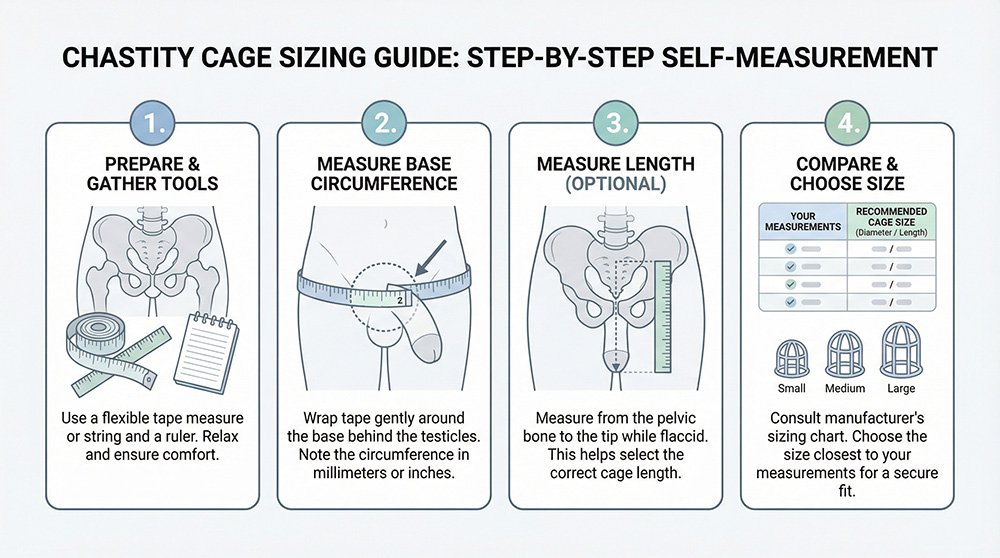
How do you correctly measure your size?

For this question, please refer to our detailed measurement blog.

What happens if a chastity cage is too small?

In most cases, it won’t fit properly. It can cause part of your penis to retract into the body, making you appear much smaller and more compressed.

What problems can occur if a chastity cage is too large?

If it’s a metal cage, it can also create a strong downward pulling sensation. If the gap between the cage and the base ring is too large, it may cause the cage to slip off.

How tight should the base ring be worn?

It should be tight enough to comfortably pass around both testicles. After putting on the base ring, you should be able to gently pull on it and confirm that the testicles don’t easily slip out or retract back into the body—this indicates a proper fit. If you experience testicular pain, it’s recommended to switch to a larger size. If there is redness, swelling, or any sign of restricted blood flow, remove it immediately.

Is numbness normal?

Numbness is mostly caused by pressure on nerves and restricted blood flow. Removing the device usually relieves it within about 5 minutes.

Should the cage touch the glans, or should there be some space?

Usually, the cage should either touch the glans or fit snugly. Leaving extra space can cause friction on the penis during long-term wear, which can be uncomfortable.

How can you tell if the fit is really correct?

If you gradually increase the wearing time and can manage to wear it for an entire day, it generally means the fit is good and you’ve adapted to being in the cage.

How often do you need to readjust after wearing it?

It depends on the type of device and individual circumstances, but generally:After short-term wear (a few hours to a day), check for friction, pressure, swelling, or discomfort. If any occurs, adjust immediately. For long-term wear, inspect the device daily or during each cleaning, and readjust the fit or position as needed to ensure proper blood circulation and skin health.

Does the cage length affect comfort?

Yes, the cage length directly affects comfort. A cage that’s too short can press on the front, causing discomfort or pain, while one that’s too long may shift around, create excessive friction, or provide insufficient support. When choosing, you should leave appropriate space based on your size and erect state to ensure both safety and comfort.

Body Warnings and Wearing Comfort

Is it normal to feel pain during the first few days?

For a newly purchased chastity cage, it’s normal to feel some pain during the first few days since you haven’t yet adapted to its size. However, don’t ignore the pain and wear it for long periods.

Why does it hurt more at night?

Due to male physiology, adult men typically experience 3–5 spontaneous erections during a night’s sleep, sometimes 2–6 times. If you wear a chastity cage while sleeping, these involuntary erections can push against the cage, causing pain.

If the skin starts to chafe or hurt, should I unlock it?

If the skin has started to chafe or hurt, remove the chastity cage immediately. Continuing to wear it will only make the problem worse.

Are stinging or tingling sensations dangerous?

If you feel stinging along with numbness, it indicates a serious risk. Remove the chastity cage immediately and monitor whether the symptoms subside over time. If they persist for a long period, seek medical attention immediately.

Why does it sometimes suddenly feel very uncomfortable?

Sudden discomfort is usually caused by the cage shifting, increased friction, restricted blood flow, or changes in body position/overnight erections. Occasional mild discomfort is normal, but if pain, bruising, or numbness persists, you should adjust or remove the cage immediately to ensure safety.

Is it normal for the number of erections to decrease?

A decrease in the number of erections is normal to some extent, especially with long-term chastity wear or frequent sexual restriction. The body may gradually adapt to controlling and suppressing stimulation. However, if it’s accompanied by pain, numbness, or decreased sexual function, it could be related to restricted blood flow or nerve pressure. In such cases, you should adjust the fit or seek medical advice.

Questions About Long-Term Chastity Cage Wear and Its Impact on Daily Life?

Is it possible to wear a chastity cage 24/7 continuously?

In theory, wearing a chastity cage continuously 24/7 is not recommended, especially for beginners. If you’re an experienced user and have already adapted to long-term chastity, you may try 24/7 wear.

Can you exercise while locked in a chastity cage?

You can exercise while locked, but avoid intense or strenuous activities. If you feel discomfort during exercise, stop immediately to prevent more serious injury.

Does chastity affect work focus?

If you wear a chastity cage long-term and are an experienced user, it may not affect your work. However, if you’re a beginner, it could impact your focus at work.

How long does continuous locking count as "long-term"?

Generally, wearing a chastity cage continuously for more than 24–48 hours is considered short-term, while wearing it for several days or even over a week counts as long-term wear. Long-term wear increases the risk of friction, swelling, and pressure on blood circulation, so you need to pay extra attention to sizing, hygiene, and the ability to unlock safely at any time.

Does locking for longer periods produce better results?

Not exactly. Locking for longer doesn’t necessarily produce better results. The “effects” of chastity mainly come from psychological control, sexual self-discipline, and the overall experience, not the length of time. Wearing it for too long can cause discomfort, friction, restricted blood flow, or skin damage, which outweighs the benefits. Short-term, comfortable, and safe wear is more conducive to long-term enjoyment and psychological satisfaction.

Can you return to a normal state after long-term wear?

Yes, you can. After long-term wear, it’s usually possible to return completely to a normal state. The body’s adaptation to a chastity device is mainly a short-term physiological and psychological response. As long as blood circulation is restored, the groin is relaxed, and you get proper rest, the skin, nerves, and erectile function will mostly recover, without causing long-term damage.

How long does it take to actually feel “truly locked”?

The feeling of being “truly locked” doesn’t happen at a fixed moment; it’s a gradual process of internalization. At first, you mainly notice the physical restriction and weight, constantly aware that it’s there, but your mind hasn’t fully settled into it. By the second or third day, your body begins to adapt, and you’re not always consciously thinking about it, while subtle psychological shifts start to appear—for example, during routine actions, you might subconsciously remind yourself that you’re restrained and check if it really can’t be opened.Typically, around three to seven days in, many people suddenly feel clearly that they’re “truly locked”—it’s no longer just wearing it, but a state that’s internalized, with a mental certainty that things are different now. After a week, this certainty often becomes quiet, stable, and almost taken for granted.The exact timing varies depending on whether it’s your first time, the comfort of the device, whether you focus more on physical or psychological experience, and whether there’s a ritual associated with locking. The true feeling of being “locked” usually doesn’t occur at the moment of locking itself, but the first time you realize you have no choice.

Can I use chastity to improve self-discipline?

Yes, chastity can help. By restricting immediate gratification, it trains you to control impulses and delay desires, which strengthens your sense of self-discipline. This discipline isn’t limited to sexual behavior—it can extend to other areas of life and habit management as well.

Will I feel bored while locked?

It’s possible to feel bored, especially at the beginning or before your mind has fully adapted. When locked, you can’t satisfy urges immediately, and your brain may keep cycling through thoughts of “wanting but not being able to.” Without other activities to distract you, this can lead to a sense of emptiness or monotony. However, as you adjust, many people shift their focus to daily tasks, bodily sensations, or psychological experiences, and this boredom gradually lessens, often being replaced by a sense of calm focus and quiet satisfaction.

How can I train myself for long-term locking?

Training for long-term locking is mainly a gradual process, paying attention to both physical and psychological responses. You can follow this approach:

  1. Start short: Begin with a few hours to a day to get used to the physical sensation and mental tension of being locked.
  2. Gradually extend: Slowly increase the duration to several days, carefully monitoring skin condition, circulation, and urination.
  3. Build mental endurance: Use meditation, distraction techniques, or a structured routine to reduce excessive focus on the device.
  4. Maintain hygiene and check regularly: Address any discomfort immediately to avoid complications.
  5. Set controllable unlock points or emergency measures: This increases your sense of safety and security.
    The key is patience and a step-by-step approach. Avoid locking for too long all at once, as this can cause physical harm or excessive psychological stress.

Will I still have sexual desire after long-term locking?

Yes, but its expression may change. During long-term locking, because sexual urges can’t be immediately satisfied, the brain gradually adjusts impulses. Some people experience a temporary decrease in libido, or their focus may shift more toward psychological experiences and the pleasure of delayed gratification.After unlocking, most people’s sexual desire returns—sometimes even stronger—because both body and mind have accumulated “longing,” and the sense of regained freedom makes sexual arousal more intense and focused. However, the speed of recovery varies; factors like physical health, mental state, and the duration of locking all influence how quickly and strongly libido rebounds.

Can long-term locking permanently change sexual desire?
Long-term locking usually does not permanently change sexual desire, but it can influence its intensity, rhythm, and psychological patterns. While locked, the inability to satisfy urges leads the brain to adjust, so some people may experience a temporary decrease in libido or find their focus shifts toward mental stimulation, delayed gratification, and the pleasure of self-control. After unlocking, most people’s sexual desire returns—sometimes even stronger than before—because accumulated longing and arousal heighten sensitivity. In rare cases, if long-term locking is accompanied by severe psychological stress or health issues, it may temporarily reduce libido, but permanent changes are extremely uncommon.
Chastity-FAQ

Questions About Cleaning and Hygiene

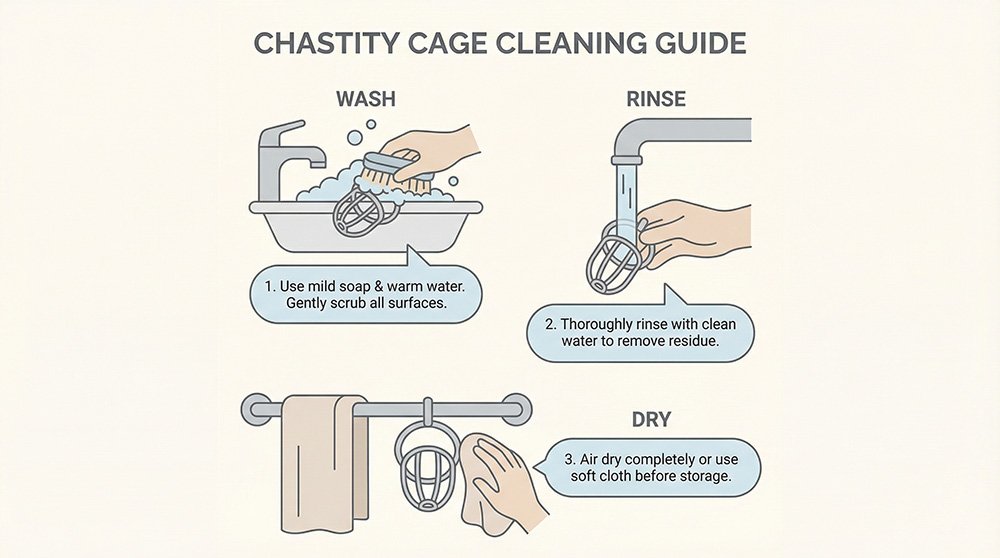
How should a chastity cage be properly cleaned?

Metal and resin chastity cages can be cleaned with warm water and dish soap, then disinfected with alcohol. Silicone chastity cages should be washed with warm water and dish soap, but should not be disinfected with alcohol or strong alkaline solutions. After cleaning, let the cage dry completely and store it in a dry place to prevent mold or other issues.

Can you wear it while taking a shower?

Stainless steel metal cages can be worn in the shower, but avoid doing it frequently to prevent rust. Resin and silicone cages are not recommended to wear while showering, as hot water may cause deformation. Chastity cages with electrical features should never be worn in the shower.

Is it normal to have discharge while locked?

It’s normal to have some discharge. Even if you’re not locked, discharge can still occur—you just might not notice it.

Is it safe to wear a chastity cage in summer or hot weather?

When wearing a chastity cage in summer or hot weather, pay attention to sweating. Sweat can lead to bacterial buildup, so it’s especially important to clean the device regularly.

How can you urinate cleanly while wearing a chastity cage?

You can choose a chastity cage with a built-in urine guide, or purchase an external urine guide to direct the flow properly into the toilet.

How can you thoroughly clean it without removing the cage?

When not removing the chastity cage, you can clean it as thoroughly as possible by rinsing with warm water, wiping the cage gaps and skin with a mild cleanser, using cotton swabs to clean hard-to-reach areas, and keeping everything dry.

Does an unusual odor necessarily mean it’s unhygienic?

Not necessarily. An unusual odor doesn’t always indicate poor hygiene—it could come from sweat, accumulated secretions, the material itself, or normal scent changes after long-term wear. However, if the odor is strong, pungent, or accompanied by discomfort, it usually signals insufficient cleaning or poor ventilation, and you should clean it promptly and check the fit.

How can friction be prevented?

Preventing friction mainly involves reducing sources of rubbing, adding cushioning, and keeping the area dry. First, choose a properly sized device with smooth materials, avoiding overly tight fits or sharp edges that press on the skin. Second, wear breathable, soft underwear or add padding to create a buffer between the device and your skin. Keeping the skin dry is also important, as sweat or moisture increases friction—using absorbent powder or breathable liners can help. During daily activities, avoid excessive tugging or bumping of the device. If you notice redness or irritation, take a break and adjust how you’re wearing it.

What should I do about folliculitis?

Folliculitis is relatively common while wearing a chastity device, because sweat, friction, and a humid environment can irritate hair follicles. Here’s how to manage it:Keep the area clean and dry: Gently wash the skin with warm water and avoid harsh soaps.Topical treatment: Apply a mild antibacterial or anti-inflammatory ointment (such as those containing benzoyl peroxide or erythromycin) to help control infection.Reduce friction and moisture: Wear breathable, loose-fitting underwear to minimize rubbing and sweat buildup.Avoid picking or scratching: This can worsen the infection.Seek medical attention if needed: If folliculitis persists, becomes very painful, produces pus, or spreads, see a doctor immediately.Until symptoms improve, it’s best to reduce device wear time to give the skin a chance to recover.

How can I prevent a chastity cage from smelling like urine?

To keep a chastity cage from smelling like urine, the key is to avoid getting urine on the device. Using a chastity cage with a built-in urethral guide (urination channel) can prevent urine from reaching the cage itself. In this case, you only need to clean the guide, and the cage will stay odor-free.

Questions About Chastity Keys and Control Dynamics

Should I give the key to someone else?

If the “other person” you’re referring to is your wife or partner, you can give them the key during play. However, you must ensure that they can access the key immediately in case of an emergency.

How can couples discuss and agree on chastity rules?

You can patiently discuss with your partner the rules you want to set and ensure that these rules do not cause harm to the person wearing the chastity cage.

What level of control is considered healthy?

Control is considered healthy as long as it does not cause excessive pain or harm.

Is it okay to keep an emergency key?

Yes, keeping a spare key for yourself is fine. This not only prevents problems if the key holder is unavailable but also protects you in case the other person refuses to unlock you.

Does the sense of control come from the key or from the mind?

It comes more from the mind than the key itself. The key is just a symbol—the real sense of control comes from your acceptance of the rules, your willingness to give up choice, and the psychological investment that results. As long as this mental framework is in place, whether it’s a real key, a virtual key, or self-imposed rules, it can produce the same or even stronger sense of control.

How can you safely end a key-holding relationship?

To safely end a key-holding relationship, you need to communicate in advance, fully unlock and clean the device, and give yourself time to mentally process the change, ensuring both physical and psychological autonomy and safety.

Is an emergency safe word or signal necessary?

Having an emergency safe word or signal is very useful, especially when the key is entrusted to someone else or if someone might need to unlock you in an urgent situation. A safe word helps verify identity, prevent misuse or misunderstandings, and enhances both physical safety and psychological security.When setting one, make it simple enough to remember but hard to guess. Clearly explain to the keyholder that it is only for emergencies. This way, even if someone has the key, only the correct safe word allows them to act, effectively protecting your privacy and safety.

Is a “safe unlocking” rule necessary?

Absolutely. A “safe unlocking” rule is a core safeguard for both your physical and mental health. It clearly defines how to unlock quickly and safely in emergencies—such as pain, injury, infection, severe discomfort, or a psychological crisis—without debate or punishment. The rule can also specify who is authorized to unlock, the method to use, the location of backup keys, and other details. Without a safe unlocking rule, long-term locking or entrusting a key to someone carries significant risk.

Questions About the Psychology of Chastity?

Why does chastity make me so aroused?

The feeling of losing control enhances arousal, the sense of being watched or attended to, mild physical stimulation is amplified, and there’s curiosity about new experiences.

Why do I feel calmer after being locked?

Feeling calmer after being locked isn’t because you’re being suppressed, but because your brain is freed from constant choices and conflicts.

Can chastity enhance the sense of submission?

Chastity “can enhance the sense of submission” because it reinforces the psychological framework and role experience, rather than due to any inherent quality of the device itself.

Why do people feel the desire to be locked for longer periods over time?

The growing desire to be locked for longer periods is usually not because “longer locking is more addictive,” but because you are strongly associating the feelings of “stability, calmness, and being held by boundaries” with being locked.

Is chastity a sexual fetish or a lifestyle?

Chastity can be either a sexual fetish or a lifestyle—it depends on how you use it and the role it plays in your life.

Can chastity affect self-confidence?

Chastity itself does not necessarily affect self-confidence. The key lies in how it is experienced and your mindset: if the rules are voluntary and align with your personal comfort, it can even enhance discipline and a sense of self-control, thereby boosting confidence. However, if you force yourself or ignore your psychological boundaries, it may lead to anxiety, frustration, or self-doubt, which can undermine confidence.

How can you tell if you’ve gone too far with it?

Going too far with chastity usually shows up as physical discomfort, excessive psychological stress, disruption of daily life, or a loss of autonomy. If any of these signs appear, it’s important to pause and restore balance.

Questions about sexual function and sexual experience

Is it still possible to orgasm while wearing a chastity device?

It is still possible to orgasm while wearing a chastity device, but the method, difficulty, and experience may differ. Using aids or focusing on localized stimulation can help achieve orgasm.

Can chastity cause erectile dysfunction?

Chastity itself does not cause permanent erectile dysfunction (ED), but improper use or excessive wearing may temporarily affect erections or penile sensitivity.

Does chastity decrease or increase sexual desire?

Chastity itself does not inherently increase or decrease sexual desire; it amplifies your psychological experience and sense of control. For those who enjoy delayed gratification and being controlled, sexual desire may increase. For those experiencing stress or discomfort while wearing it, sexual desire may temporarily decrease.

Is it normal for sexual desire to surge after being unlocked?

Yes, it’s normal. This is a natural physical and psychological response. During the locked period, sexual desire is suppressed and anticipation builds up, so releasing the restriction can cause a sudden surge of sexual arousal—much like long‑accumulated pressure being released. This reaction is common and harmless in the short term.

Can chastity change sexual preferences?

Chastity itself does not forcibly change sexual preferences, but through delayed gratification, psychological engagement, and ritualization, it may make you more aware of mental pleasure, a sense of control, or specific scenarios. This can lead to new insights into your experiences or reinforce existing preferences, though it usually does not fundamentally alter your core sexual orientation.

Questions about chastity devices and products?

Are metal cages safer than plastic cages?

In fact, safety does not depend solely on the material but on the design, size, and how it is worn. Each material used for chastity cages has its own advantages.

Are cheap chastity cages reliable?

Cheap chastity cages are not necessarily “completely unreliable,” but they often fall short of mid‑ to high‑range products in terms of safety, comfort, and durability. The key is to know where they might fail, when they should not be used, and how to judge whether they are safe.

What is the difference between a flat ring and a curved ring?

The difference between a flat ring and a curved ring mainly lies in their shape, wearing comfort, and how they fit at the base. Curved rings conform better to the body’s structure and are more suitable for long-term wear.

Is a spiked design safe?

Spiked chastity cages can be used safely, provided the spikes are not sharp, the size is appropriate, wearing time is short, and regular checks and cleaning are done. For beginners or long-term wearers, rounded or small bumps are safer; sharp spikes are only suitable for short-term experiences.

Which type of cage is best for long-term wear?

For long-term wear, you need to consider comfort, hygiene, safety, and psychological experience. For example, the cages in the “Cobra” category on our website are all suitable for extended wear.

Is a lightweight design really more comfortable?

Generally, a lightweight design is indeed more comfortable because it’s less heavy, puts less pressure, fits the body better, and reduces friction and pressure marks, making it suitable for long-term wear. However, comfort also depends on the material, size, and how it’s worn—some lightweight devices with poor design can cause uneven friction or shift easily.

Is it necessary to rotate between multiple devices?

It’s not strictly necessary, but rotating between multiple devices has several benefits: it can reduce localized pressure, lower friction and pressure marks, extend the device’s lifespan, and provide psychological variety, preventing aesthetic or mental fatigue from wearing a single style for a long time. Whether it’s needed depends on wearing frequency, comfort, and personal preference.

Is it necessary for products to be updated frequently?

It’s not necessarily required. Frequent updates in chastity devices are mainly aimed at improving materials, comfort, lock safety, or design aesthetics. However, if your current device is safe, comfortable, and meets your needs, frequent changes are more about psychological novelty or collecting interest rather than practical necessity.

How can I prevent a chastity cage from shifting or sliding?

First, make sure the cage is the right size—neither too loose nor too tight—and fits the shape of the penis and scrotum. Next, you can use soft padding or ring inserts to fill gaps, increasing friction and stability. Then, adjust the angle when wearing it so the cage naturally sits in a comfortable position, minimizing movement. Finally, choose a cage with a well-designed structure and non-slip materials—high-quality devices themselves greatly reduce sliding.

What should I do if a chastity device rusts or corrodes?

A rusted or corroded device must be addressed or replaced immediately, otherwise it can damage the skin or cause the device to fail.

Common questions about chastity safety?

What should you do if the lock gets stuck?

If you get stuck in a chastity device, don’t panic—safety comes first. Use a spare key to unlock it. If there’s no spare key, you can try using lubrication to assist or carefully use tools to remove it.

Is it necessary to have bolt cutters ready?

In general, it’s not recommended to keep bolt cutters on hand. Bolt cutters are a destructive option and can be dangerous—they may cause injury to yourself or damage the cage in a way that creates sharp edges, increasing the risk of accidental cuts.

How do doctors view chastity devices?

Doctors generally don’t comment on the sexual or psychological aspects of chastity devices. Their focus is on safety and health. Correct use, proper sizing, maintaining hygiene, and paying attention to bodily signals are the principles that doctors generally endorse.

Is it safe to wear a chastity device when you’re sick?

It’s not recommended. When you’re sick, your body’s ability to recover is reduced, which can increase swelling, pain, or the risk of infection. You should pause wearing the device and resume only after recovery.

In which situations should you absolutely not wear a chastity device?

Situations where you should absolutely not wear a chastity device include: the presence of infections, skin lesions or ulcers, severe swelling, numbness or tingling in the genital area, fever or general illness, during sickness, circulatory problems (such as varicose veins or vascular issues related to diabetes), and any situation where you cannot ensure the device can be safely removed at any time.

What is the greatest risk of long-term wear?

The greatest risk of long-term chastity device wear is physical and skin damage, including pressure marks, friction injuries, restricted blood flow, or infection. It can also cause psychological stress and anxiety. Ignoring hygiene, using inappropriate materials, or wearing the device too tightly significantly increases these risks, so regular checks, cleaning, and periodic breaks are essential.

Which is more important: physical signals or psychological signals?

Both are important, but from a safety perspective, physical signals take priority. Physiological responses such as pain, pressure marks, numbness, or redness directly indicate potential harm and require immediate attention. Psychological signals like anxiety, discomfort, or a sense of loss of control are also important, affecting enjoyment and sustainability, but ignoring physical signals can lead to long-term damage.

Is it possible to learn and experiment at the same time?

Yes, but it should be done gradually, combining learning with practice. Start by understanding the basics—size selection, cleaning methods, and safety precautions—then try short-term wear first. Gradually increase the duration or complexity, while paying close attention to both physical and psychological signals to ensure safety and comfort.

Common questions about community and social aspects?

Is chastity a niche interest, or is it actually quite common?

Chastity is actually more niche than many people think, but it’s not rare. It’s relatively common within BDSM, sissy, cross-dressing, or sexual exploration communities, especially online and among adult toy enthusiasts. However, among the general public, it is indeed a niche interest.

Is chastity more common among gay men?

Chastity is indeed relatively more common among gay men, especially in circles with interests in BDSM, sissy play, bondage, or sexual role-play. However, not every gay man engages with or enjoys it. Its prevalence depends more on personal interests, sexual preferences, and community culture than on sexual orientation itself.

Is chastity part of BDSM, or is it independent?

Chastity can be considered both a branch of BDSM and an independent practice. Within BDSM, it usually involves elements of dominance/submission, control, and restraint. However, many people engage in it purely as a sexual interest or form of self-exploration without involving other BDSM activities. So, it can fit into the BDSM framework, but it can also exist independently.

Are experiences shared on Reddit reliable?

Experiences shared on Reddit can be used as a reference, but they shouldn’t be taken at face value. They are personal accounts and advice from enthusiasts—often genuine, but sometimes lacking professional insight, scientific validation, or consideration of individual differences. The quality of posts can also vary widely.

How can you tell if information is suitable for you?

To determine if information is suitable for you, consider your physical tolerance, psychological comfort, and safety feasibility. Use your own experience as the core reference, drawing on others’ experiences without following them blindly.

Is it dangerous to share photos online?

If you’re only sharing photos of wearing the device, it’s generally not dangerous. However, if you accidentally reveal information about your job or your family, it can be very risky. So when sharing images online, be sure to pay close attention to these details.

Is it normal to feel lonely in this kink?

Yes, it’s normal. Because this kink isn’t mainstream and is relatively niche, it’s common to have fewer people to talk to about it, so feeling lonely is a normal experience.

How can I meet like-minded people?

You can make friends in various chastity communities, but when connecting with people online, be sure to protect your personal privacy.

Questions about the deeper psychological aspects of chastity?

Can chastity be a form of self‑punishment?

Chastity itself is not inherently a form of self‑punishment. It is more about experiencing control, ritual, and psychological engagement. However, in some cases, if it is worn with feelings of shame, guilt, or compulsion, or if being locked is treated as something that “must be endured,” it can take on elements of self‑punishment. The key lies in the underlying motivation and emotional experience: whether it’s for self‑exploration and pleasure, or for punishing oneself.

Why do I feel a stronger desire to be close to my partner after being locked?

The increased desire to be close to your partner after being locked mainly comes from psychological attachment and emotional projection. Losing some autonomy while locked strengthens trust and dependence on your partner or keyholder, while also creating a longing for emotional comfort and validation. This psychological engagement makes both your body and emotions more inclined toward closeness, enhancing intimacy and emotional connection.

Questions about partner dynamics and interactions in chastity relationships?

What should you do if your partner finds this strange?

If your partner finds it strange, first respect their feelings and don’t force them to accept it. You can explain the origin of your interest, your psychological experience, and the safety measures involved, emphasizing that it’s a voluntary exploration rather than a pressure. If needed, start with short-term or virtual experiences to help your partner gradually understand. Keep communication open to ensure both parties feel comfortable and the relationship remains harmonious.

What should you do if your partner wants to play but you don’t?

If your partner wants to play but you don’t, your refusal is entirely valid. You can honestly express your feelings and boundaries rather than going along unwillingly. At the same time, acknowledge your partner’s interest, but make it clear that this doesn’t mean you have to participate. The key is open communication and mutual respect—discuss alternatives that don’t involve things you’re uncomfortable with, or simply maintain separate boundaries, ensuring that any intimate activity is based on mutual consent and comfort.

How to deal with a partner’s jealousy or insecurity?

Dealing with a partner’s jealousy or insecurity relies on empathy rather than argument: first, acknowledge that their feelings are real and listen patiently to what worries them; clearly communicate your intentions and boundaries, emphasizing that this is about experience, not replacing the relationship or shifting emotional needs; strengthen their sense of security through transparent communication, adjusting rules, increasing quality time, and offering reassurance, showing that you prioritize the relationship and are willing to make tangible changes for them.

Summary

We’ve summarized some common questions about chastity, focusing on areas such as beginners, sizing, discomfort, long-term wear, hygiene, control dynamics, psychology, sexual function, devices, safety, community, rules, and partners. We’ll continue to update this content. If you have other questions about chastity, feel free to post them in the comments and we’ll answer them. Wishing you a perfect chastity journey.
Shopping Cart